NOTES & EXPLORATIONS
01_Numpy 基础
Table of Contents
1. 简介
2. 地位
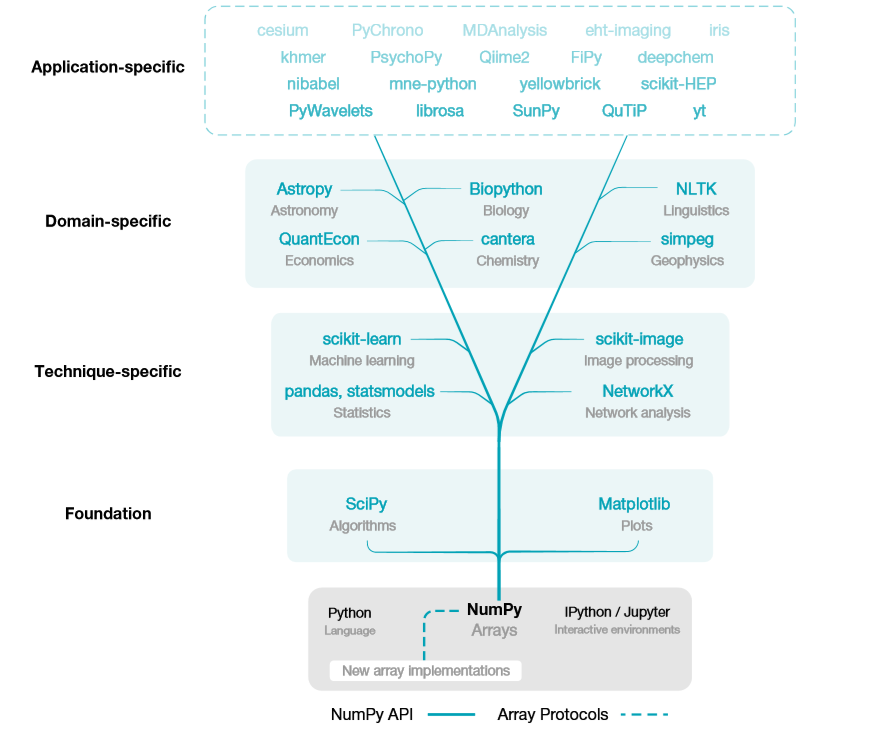
NumPy 是Python数据科学生态系统的基础1
NumPy is the base of the scientific Python ecosystem.
3. 基本概念
4. 创建数组对象
4.1. N维数组
# zeros创建0矩阵
array=np.zeros((3, 4))
# ones创建1矩阵
array=np.ones((2, 3, 4), dtype=np.int16)
# empty不初始化数组,值随机
array=np.empty((2, 3))


# 创建[0, n-1]的数组
np.arange(3)

# 创建1-10范围类,3个数
np.arange(1, 10, 3)

# 取均值步长
np.linspace(0, 1.5, 3)
# array([ 0.  ,  0.75,  1.5 ])


##
#创建随机
4.2. one-hot
a = np.array([1, 0, 3])
b = np.zeros((a.size, a.max()+1))
b[np.arange(a.size),a] = 1
b
>>>
array([[ 0.,  1.,  0.,  0.],
    [ 1.,  0.,  0.,  0.],
    [ 0.,  0.,  0.,  1.]])
5. 索引
np.ravel_multi_index()工作如何?
array
>>>
# shape (30,2)
# array[1]'s unique value count is 5

dims=(30,5)
# 线性index,linear indices
lidx=np.ravel_multi_index(array.T,dims)
>>>
[15,23...,..]
# shape=150
此函数为我们提供了线性索引当量数。它接受,设置为列的2D数组n-dimensional indices和该n维网格本身的形状,这些索引将映射到该n维网格上并计算等效的线性索引。
6. 数学运算
a = np.array([20, 30, 40, 50])
b = np.arrange(4)
# 减法
c = b - a
# 乘法
b * 2  # 新建一个矩阵
b *= 2 # 直接改变b,不会新建一个矩阵 a += 2 同理
# 次方
b ** 2
# 判断
a < 30
# array([ True, False, False, False], dtype=bool)
10 * np.sin(a)

# 矩阵乘法
A = np.array([[1, 1], [0, 1]])
B = np.array([[2, 0], [3, 4]])
A.dot(B)
B.dot(A)
np.dot(A, B)

# sum, max, min
a = np.arange(12).reshape(3, 4)
array([[ 0,  1,  2,  3],
       [ 4,  5,  6,  7],
       [ 8,  9, 10, 11]])
# 所有元素sum, min, max
a.sum()
a.max()
# 使用axis=0按列, axis=1按行
a.sum(axis=0)
array([12, 15, 18, 21])
a.sum(axis=1)
array([ 6, 22, 38])

# 通用函数
B = np.arange(3)
np.exp(B) # 求e的次方
np.sqrt(B) # 开方
C = np.array([2, -1, 4])
np.add(B, C) # 相加
7. 数组shape操作
a = np.floor(10*np.random.random((3,4)))    # <1的小数*10,取整
array([[ 9.,  6.,  3.,  8.],
       [ 2.,  8.,  4.,  2.],
       [ 5.,  3.,  3.,  1.]])
# 形状
a.shape
(3, 4)
# 打平,返回array
a.ravel()
array([ 9.,  6.,  3.,  8.,  2.,  8.,  4.,  2.,  5.,  3.,  3.,  1.])
# reshape 生成新的
a.reshape(2, 6)
a.reshape(3, -1) # 给定一个,自动计算另外的
# resize 改变自己
a.resize(4, 3)
# 转置
a.T
res=np.where(condition, x, y)
# 满足条件(condition),输出x,不满足输出y。

res=np.where(condition)
# 返回索引
8. 参考资料
一个问题,通向下一个问题。
继续探索知识库 →